
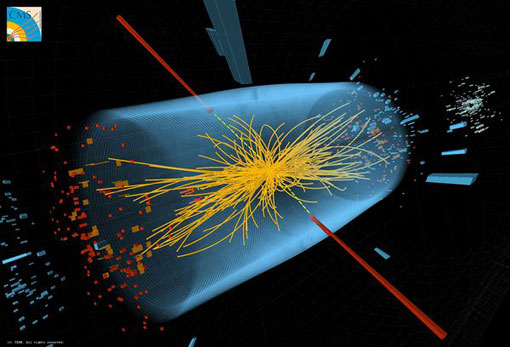
The Higgs Boson:

Where’s the Higgs Boson for nutrition
Why We Need to Discover a Nutrition Boson
This week the news hit headlines around the world that the Higgs boson or “god particle” had been discovered at the large European CERN particle accelerator. Although I am far from a physicist, my understanding is that this elusive subatomic particle helps explain the big bang theory of the origin of the universe and also explains what gives all matter mass, including our own bodies. Even though this is obvious triumph for science, I also find myself wondering why science hasn’t been able to explain why our bodies are getting so fat.
The scientists think they know why this is so—we are simply eating too much food and not exercising enough. Unfortunately this calories in/calories out theory of obesity hasn’t made a dent in the obesity epidemic. As a matter of fact, while using this theory the problem has become much worse with 70% of adults now overweight or obese and children are rapidly catching up. To me it sounds like the scientists need a new theory.
The same is true for common brain disorders such as depression, anxiety disorder, ADHD, PTSD, eating disorders, bipolar II, fibromyalgia, autism and similar conditions. Despite the best efforts of our top scientists these conditions continue to increase in incidence often at dramatically accelerating rates. When you ask them why this is so the standard answer is “We don’t know.” In science this is not an answer but rather an admission of failure.
I have devoted the last several decades of my life to answering these important questions. We now know that excessive fructose primarily from sugar and HFCS is the driving force behind insulin resistance and central obesity. When someone with insulin resistance consumes high glycemic carbohydrates, especially from grain, their brain is subjected to magnified glucose spikes. Because too much glucose is toxic to nerve cells, over time these glucose spikes can trigger a condition called “sugar-brain”. People with sugar-brain start to crave sweet and starchy food pushing them to consume more of the very food that is frying their brain.
They also start to develop subtle brain dysfunction symptoms like fatigue, anxiety, mood swings and difficulty concentrating and focusing. Because the brain plays a key role in regulating total body fat, people with sugar-brain start to store extra fat like a beer in fall even when they don’t overeat.
Although sugar-brain could be viewed as a minor nuisance, over time it can transition to a serious medical problem called Carbohydrate Associated Reversible Brain syndrome or CARB syndrome. People with CARB syndrome can develop up to 22 brain dysfunction symptoms that interfere with their ability to function and they continue to pile on extra body fat even as they lose lean body mass from dieting.
Thus the type of food you eat has a much bigger impact on your health than the amount you eat. The writer Gary Taubes author of “Good Calories, Bad Calories” and “Why We Get Fat” figured this out years ago and he isn’t a scientist. Ten year old Haile Thomas from Tuscon is leading a crusade to help other kids cook and eat healthy food with her HEAL festival (Healthy Eating and Lifestyle) and Healthy Girls Adventures Club. Haile certainly isn’t a scientist. Although I am a physician I am not a research scientist and the sugar=brain and CARB syndrome concept evolved from treating thousands of patients like you.
When common everyday folks seem to be leading the charge in finding effective measures to battle obesity and other common chronic illnesses, it’s time for the scientists to wake up and take notice. Who knows, perhaps some day we may be reading about the Haile, Wilson or Taubes boson—the magic information that finally trumps the old and outdated scientific ideas about food and nutrition that have lead us down the path to more disease and disability. Yes it does somewhat implausible but don’t count us out. The future belongs to brave independent thinkers who are willing to challenge the ideas of the scientists that simply aren’t working.