
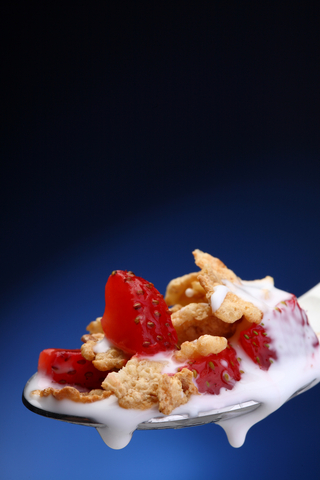

kid eating breakfast
April 20, 2012 By Pat Hartman for Childhood Obesity News
Childhood Obesity News has been exploring the art and science of food porn (or foodporn), including the ways in which food is visually enhanced, sometimes for the purpose of advertising, and sometimes just because. An entire enormous genre of photography is focused on the depiction of food.
Photoshop and its brethren may have made the real profession of food photography into a lost art. Back in the day, the artistes would fiddle around for hours, adjusting the lights and coating the food with glycerine. They got up to all kinds of tricks to achieve a tactile, tasty look.
comments
William L. Wilson, M.D. says:
April 24, 2012 at 10:48 am
Unless we understand why certain food is bad for us, then focusing on packaging may well lead to a dead end. We first need to determine what part of our food is truly “pornographic”. Is it fat? It is calories? Is it carbohydrates? Is it sugar? Until we answer this basic question, we will be groping in the dark.
As my friend Dr. Robert Lustig recently proposed in the Journal Nature, it’s time to start regulating sugar (sucrose and HFCS) because they are clearly chronic toxins like tobacco and alcohol.
Unlike acute toxins, you can consume chronic toxins for years without apparent ill effects–that is until suddenly one day the wheels fall off. In medicine we now spend a great deal of money, time and resources dealing with the adverse affects of sucrose and HFCS. It is now clear from research that excessive fructose from sucrose and HFCS is the driving force behind insulin resistance and central obesity.
When you combine excessive fructose with high glycemic carbohydrates, you eventually trigger a reversible brain dysfunction disorder we call Carbohydrate Associated Reversible Brain syndrome or CARB syndrome. Healthy brains play a key role in auto-regulating fat stores and people with CARB syndrome lose this function and begin to store excess fat at any caloric intake, even as they lose lean body mass by dieting. You sometimes have to measure body composition to see this extra fat because it isn’t always apparent by relying on weight or BMI.
Carbohydrate cravings are hard wired into our brains as a survival mechanism. Our brains use glucose levels to monitor food intake and when the food starts to run out prior to a famine glucose levels begin to fall. At first your brain responds by ramping up hunger signals. If you don’t respond to these signals by eating, glucose levels fall to dangerously low levels. At this point your brain pulls out the big gun—carbohydrate cravings, because eating a low glycemic carbohydrate is the fastest way to restore normal glucose levels.
This system worked fine when we lived in an environment without high glycemic carbohydrates. When you consume a high glycemic carbohydrate, especially if you have insulin resistance from consuming too much sugar, your blood glucose rapidly rises and then crashed to below normal. Your brain doesn’t know how to read glucose spikes but it does know how to read low levels or hypoglycemia—it’s time to eat! When you respond by eating another high glycemic carbohydrate you again generate another glucose spike followed by a crash. Your brain responds by sending out more hunger signals and carbohydrate cravings.
When glucose levels remain unstable, your brain interprets this as a possible famine on the horizon and pushes you into a famine-protective metabolic mode where you start to store extra fat at any caloric intake. We are programmed to store extra fat only when the food is running out, not when we are surrounded by endless amounts of food.
Thus it isn’t true that we are somehow “programed” to overeat when there’s a lot of food around. A healthy person with a normal brain can consume a broad range of calories without storing extra fat as long as they stay away from sucrose, HFCS and high glycemic carbohydrates.
to read the rest of the story: http://childhoodobesitynews.com/2012/04/20/packaging-photography-and-presentation/