
One of the first things I noticed after I purchased my condo in Mazatlan Mexico in 2003 was the massive amounts of Coca-Cola that were being consumed by virtually all Mexicans at virtually every income level. I later found out that per capita, Mexican’s are the highest consumers of Coke in the world, averaging over 30 gallons per person a year. As a result, they also have a massive epidemic of metabolic syndrome, obesity and type II diabetes. It has been estimated that sugary beverages like Coca-Cola kill more than twice as many people per year as the illegal drug trade yet few Americans are aware of the Mexican Coca-Cola crisis.
My “Cola” Education
To understand this current fiasco, I first had to look back in Mexican history. Safe drinking water has always been a problem in Mexico and years ago Coca-Cola and other soda companies managed to corral much of the available safe water supplies to make soda. Virtually all Mexican children went directly from the breast to Coca-Cola or other sugary beverages and they continued to consume it in massive amounts throughout their childhood and adult lives. Coca-Cola also went out of their way to directly integrate Coke into the everyday lives of various native populations. For many years the Chamula Indians have used Coca-Cola in virtually all of their religious practices, which tend to be a mixture of Catholicism and ancient native rituals. The Coca-Cola company has been more than happy to participate in this rather bizarre state of affairs. I don’t know about you, but I would be totally spooked if Coca-Cola made any type of appearance in my church.
Coca-Cola’s Evil Playbook
Over the years Coca-Cola more or less took over politics in Mexico, through a system of bribes and free Coke products for store owners and citizens as long as they made the right choice in the voting booth. Store owners were given free refrigerators that could only be used to store Coke products. Years ago I was caught in a nasty hurricane in Cancun and we were evacuated from the fancy beach front hotels into downtown Cancun, which is basically one large ghetto. They dropped us off at a grade school without food or water and we quickly started to duct tape the windows. The school was surrounded by a high fence but I managed to communicate with several young Mexicans who showed up to see what all the fuss was about. I don’t speak Spanish and their English was minimal, so we got by with sign language. I indicated that we needed something to drink and handed them $20 through the fence. They quickly disappeared and I didn’t expect to see them again. About 15 minutes later they showed up with their arms loaded with Coca-Cola!
This example reflects how Coca-Cola many years ago became an integral part of the fabric of everyday life and the political process in Mexico and their influence has only grown over the years. As a result of all this muckraking, I noticed that at virtually all family gatherings in Mexico, there are often dozens of two liter bottles of Coke to drink with no other choices available. I remember watching a street person riding a bicycle from dumpster to dumpster looking for anything of value. He was also carrying a half empty 2-liter bottle of Coke. The excellent investigative blog “The Russells” outlines some of the more offensive and corruptive actions of Coca-Cola in the United States, but these practices are part of the same evil playbook they use in every country in the world and Mexico stands as their shining example of so-called success.
Obesity in Mexico is Now the Norm
Mexican officials began to hit the panic button when obesity rates in Mexico shot past the rates in the United States, making Mexico the most obese laden country on the planet. The current prevalence rate of overweight and obesity in Mexico is 33.2% in school aged children, 36.3 percent in adolescents and an astounding 72.5 % in adults! After a pitched battle with the soda industry led by Coke, two years ago Mexico initiated a soda tax of 5 cents per 35 liters of soda. It was hard to imagine that this small tax would have any impact on Mexico’s favorite beverage, but over the first two years of the tax soda consumption dropped about 7% and it dropped even more among poor families. Public health officials in Mexico are trying to increase the tax, but are being met with fierce opposition from the soda industry. Jorge Terrazas, the head of ANPRAC, the carbonated beverages trade association in Mexico City, stated “There’s no conclusive scientific evidence demonstrating the relation between the intake of soft drinks with overweight.” Oh, really. With over 70% of the adult population in Mexico overweight or obese, just how bad does it have to get?
Just How Bizarre Can it Get?
Then this story took an even odder twist. Some of Mexico’s leading proponents of the soda tax started to receive disturbing text messages about their associates or family members. These messages were finally traced to an invasive form of spyware developed by NSO Group, an Israeli cyberarms dealer that sells its digital spy tools exclusively to governments and that has contracts with multiple agencies inside Mexico. If you can’t beat them, beat them up!
Mexicans Are Desperate For Solutions
The success of the Mexican soda tax has stimulated similar taxes in other countries and in several US cities. It’s a small start but it’s better than nothing. If you tell the 9 million people living in Mexico City to exercise, good luck with that. It’s a different story in our city of Mazatlan where there is a 13 mile malecon walkway along the ocean. Every morning and evening it fills up with Mexicans who are running, walking, biking or rollerblading. After meeting many of these folks, I am convinced that they are desperately looking for ways to improve their health.
Coke Takes on the Cartels
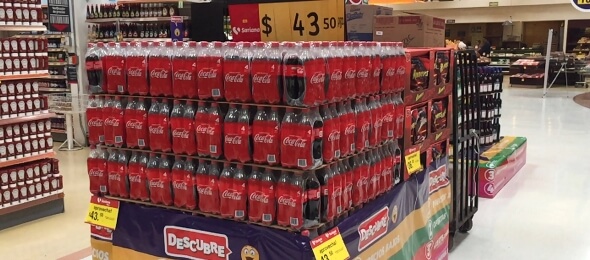
I never drink sugary soda but I will occasionally drink beverages like Coke Light or diet Coke after one of my 8 miles walks on the Malecon, when they are the only cold carbonated beverage available. One day after my walk I went to one of Mazatlan’s largest grocery chains to buy some Coke Light. The above picture shows what I found. There were multiple huge displays for old fashioned sugary Coca-Cola, but I could only find a few bottles of Coke Light hidden in a small refrigerator. If anyone thinks that the soda industry will give up and walk away from this battle, think again.
In 2016 one of the drug cartels demanded that Coke pay one million dollars to keep their distribution center in Southern Mexico. When Coke refused to pony up, the cartel began to burn Coke trucks, eventually forcing them to move their distribution center, but of course this had no impact on Coke consumption. Even though the Mexican government seems to be afraid of directly taking on the drug cartels, Coca-Cola barely blinked in the face of this extortion.
Does Coke Own Mexico?
According to their own figures, Coca-Cola has invested more than 12.4 billion dollars in Mexico over the past decade. They are also one of Mexico’s largest employers, generating more than 90,000 direct jobs and 800,000 indirect jobs. At times it looks like Mexico will have to cut off its own head to remove the plague of sugary beverages from its country.
We Will Need Patience, Persistence and the Wisdom to Follow in Mexico’s Footsteps
I find myself asking, where is the solution? I believe that a combination of taxes and public education will eventually turn the tide. This combination worked with tobacco. When I started practicing medicine, physicians were smoking in the hospital in patient care areas. Today most hospital campuses are completely smoke free. When it comes to sugary beverages, even patients with diabetes are free to order beverage like Coca-Cola with their hospital meals. There is even a company called Enliven whose mission statement reads: “We help restaurant companies, airports and hospitals successfully navigate the complex—and lucrative—world of exclusive beverage contract negotiations with Coca-Cola, Pepsi and other brands. Beverage deals are very different in every sector, and every nation. You benefit from our expertise in three sectors, globally.”
Get Ready For World War III
Wow–that sure sounds like the mafia or drug cartels at work! I personally think that the battle with Big Soda will make the battle with tobacco look like a minor skirmish. I’m not suggesting that we throw up our hands and walk away, because the health of the global population is a stake. We need to dig the trenches to get ready for a prolonged and vicious war with Big Soda. If Mexico can take the first steps, then we need to give them our support and watch their back, because clearly this will not be a bloodless war. Stay tuned.
Not to change the subject, but I can’t help wondering if drug kingpin Chopo Guzman’s recent apparent smiles in a New York Court were for his beautiful young wife or because he has access to Coca-Cola in his high security jail in Manhattan. After all, 23 hours in solitary confinement seems a bit sweeter if you have access to Coca-Cola, the ultimate “sweet treat”.
Coca-Cola and the Most Dangerous Criminal in the World
Guzman was originally arrested in a condo about a block from our condo in Mazatlan. He was placed in the highest security jail in Mexico, only to later escape through a mile-long tunnel dug beneath his cell. He was later recaptured and the kingpin’s sprawling sanctuary in the city of Los Mochis featured a modern kitchen with stainless-steel appliances and a fridge stocked with eggs, cheese, sausages, tortillas and Coca-Cola. What more could a bad boy want? After all, don’t things go better with Coke? I would have to say, not always.
On the news front just this week Coca-Cola announced that they have hired James Quincey to be their new CEO. His picture on the front page of the WSJ Business section shows a trim, healthy appearing young man. He certainly hasn’t been drinking his fair share of Coke! During the interview he was drinking Vitamin water, a Coke product without sugar. He will certainly have his challenges. He is planning to move towards selling more water, juice, dairy, tea and other beverages even though 70% of its sales volume still comes from sugary soda. They have purchased several brands that don’t have sugar like Vitamin Water but they have also added brands like sports drink Powerade that is loaded with high fructose corn syrup. Thus they clearly are still a sugar-centric company. Although it’s theoretically possible for Mr. Quincey to navigate the choppy waters ahead when it comes to sugary drinks, I certainly hope he knows where his life jacket and life boat are located!
Astonishing. Great work! The Coke heading south is even more evil than the coke heading north.
Very well said.