
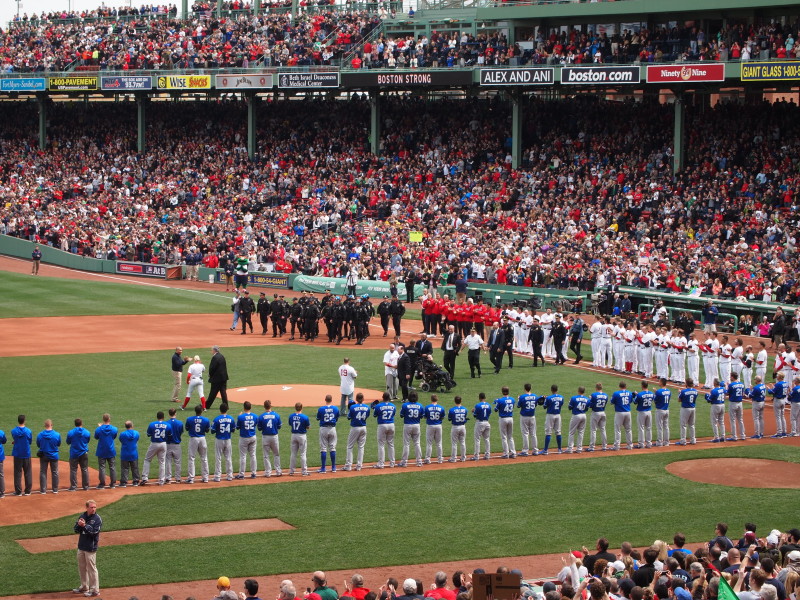
I usually devote this blog to health issues. Today I want to discuss a different topic—the courage, resilience and toughness of a city—my home of Boston, Massachusetts. It’s been quite a week here in Boston. Despite living in this country for over six decades, I’ve never seen anything quite like it. Boston loudly celebrated as the second terrorist was captured alive after a massive manhunt. Less than 24 hours later I snapped this picture at an emotional Red Sox game, a form of citywide catharsis.
At Times Like This We Need Sporting Events
Before the game there was an emotional ceremony to honor the people who had made this a special week in Boston, one that we will never forget. To the roar of the crowd, they first introduced the Boston Marathon volunteers who responded with grace and valor when the bombs exploded near the finish line of this iconic race. Next they introduced Matt Patterson, a firefighter and Army veteran from Lynn who was eating at a restaurant when the bombs went off. He immediately rushed through the smoke to save the life of a little boy who was seriously injured, totally disregarding his own safety in a chaotic environment.
Next was Stephen Byme who was standing with relatives and friends near the finish line. The bomb filled his upper body with shrapnel and his clothes caught on fire while two of his friends lost their legs. He limped proudly to the middle of the field to accept the accolades of the crowd. They then introduced Dick and Rick Hoyt to represent the runners. Dick has pushed his disabled son in a wheelchair across the finish line on Boylston Street for the past 31 years. Over decades this team has established themselves as an iconic presence in the Boston Marathon through unbelievable grit and hard work. As an inspiration for couch potatoes, Dick is now 71 years old! Next came our Governor Deval Patrick and the various police organizations and Federal Agencies who did everything possible to ensure that our citizens were safe and free from harm. The celebration reached a peak when Neil Diamond sang his classic song “Sweet Caroline”. There wasn’t a dry eye in this iconic sports facility.
A Small-Town Guy in a Big City
These events also affected me on a deep and personal level. After moving to Boston over four years ago, I am now proud to call Boston my home. Don’t get me wrong–since moving here from a small town in Northern Minnesota, I found Boston to be interesting and stimulating. It’s a community seeped in American history with a large multicultural population, yet until this week I didn’t feel totally comfortable calling Boston my home. This week I have been forced to examine why this is so. I know that I sometimes stand out because I continue to pronounce my Rs—for example I say “water” rather than “wata” and I must admit that I am often intimidated by the fast pace and traffic in a large Eastern city, but I suspect that my reasons for not always feeling at home likely run deeper.
For over 30 years I was a primary care physician in Chisholm, a town of 5,000 on the Iron Range in Northern Minnesota. I grew up in the Twin Cities area but was attracted to the Range because it is an interesting area dominated by tough, working class people. I feel most comfortable in this type of setting because of my experiences during college and Medical School. When it came time to pick a college, I chose Macalester College in St. Paul. I liked the international flavor of their student body and their reputation for excellence. Our family was solidly middle class, so I didn’t qualify for a scholarship based on need, the most common way of subsidizing a college education at the time. My parents informed me that they couldn’t afford to send me to the college of my choice.
My Working Class Roots
As a somewhat strong-headed young man, I decided I would figure out a way to make it work. While my classmates often spent their summers traveling abroad, I spent mine working two fulltime jobs. During the school year I worked part-time and supplemented my income with student loans. The only jobs I could get tended to involve extremely hard physical work, often under dangerous conditions. I worked in a metal heat-treating plant called Flame Industries. The plant still operates under the name Flame Metals. I worked the night shift where temperatures were often greater than 100 degrees. I loaded metal parts into ovens the size of a truck and on several occasions I barely avoided life-threatening burns. I also worked as a janitor in a factory that made rubber O-rings, an extremely dirty environment. I then worked at a candy company polishing jellybeans in large devices that looked like a cement mixer. I know—you had no idea that jellybeans had to be polished! After working my factory shift I would transition to pumping gas for another eight hours.
During these long hours of extremely hard physical work, I met many interesting people who relied on these jobs to support and feed their families. Most of these folks had little formal education, but they did have their own form of intelligence and wisdom gleaned from years of backbreaking work often under harsh conditions. Over the years I grew close to many of my co-workers and grew to respect them in a new way. Since then I have tended to gravitate to areas and groups with a solid working class background.
After graduating from Medical School, I gravitated to the Iron Range in Northern Minnesota where I practiced for over 30 years. My grandfather worked in the steel mill in nearby Morgan Park, Minnesota and I immediately felt at home in this community. The Iron Range is populated with numerous towns and villages spread along the rich vein of iron ore that transects Northeastern Minnesota. Immigrants from various European countries came to the Range in waves to work in the iron mines. Even today these various ethnic groups can be easily identified. Today the mines mainly process taconite, a form of low-grade iron ore. The people on the Range are tough, resilient, hardworking and extremely loyal to their communities—my kind of folks.
Bright Lights, Big City
I met my Greek wife Irene when she moved to the Iron Range to work as a physician to obtain her Green card. Once she had the card, she wanted to move away from the brutal winters back to the Boston area where she received her medical training. I was somewhat intimidated by the thought of moving to a large city on the Eastern seaboard, but after a few visits to the Boston area I decided to make the move. My initial impressions of Boston were positive. It has a strong working class core and the locals seemed to be tough and resilient—again, my kind of folks. I now work as a Hospitalist at Addison Gilbert Hospital in Gloucester, Massachusetts. Gloucester reminds me of the Iron Range, except they catch fish rather than mine iron ore.
After living here for over four years, I started to adapt to big city life but I can’t say that I felt that this was my true “home”—that is until this week. In a large city it’s sometimes hard to feel the same sense of community that you experience in a small town. After watching how the residents of this remarkable city responded to an unthinkable tragedy, my perspective has changed. Terrorists had disrupted their most hallowed event. The Federal Government shut down the city for over 24 hours and the citizens immediately complied. Common everyday folks put themselves into immediate danger to help those who had been wounded by the bombs. They also rushed to aide those visitors who were traumatized by the violence. Bostonian’s opened their hearts and homes to complete strangers. It stuck me like a bolt of lightening—these are my kind of people. Loyal, giving, selfless, touch and resilient—this is the Boston that I now call my home. Thank you Boston for showing me the way back home. As David Ortiz so aptly said at the game, “This is our fucking city and nobody is going to dictate our freedom!” Sorry—I can’t really say it any better.
This past week I have not only been stunned by the horrible and terrifying events, I have also been awed by the courage, resilience and toughness of the people of Boston. As the Standells sang in their classic song “Dirty Water”, I can now say: “Oh, Baw-stun, you’re my home”. I ask that you join me in my prayers that the victims of this tragedy experience a speedy recovery.