
I’m fairly certain that you’ve heard about the concept of “gateway drugs”. The gateway theory is based on the idea that those who use substances like alcohol, nicotine or marijuana are much more likely to move on to more dangerous and addictive drugs like heroin, methamphetamine and cocaine. Although this connection isn’t universally accepted by all experts, there is a fair amount of empirical and research data supporting the concept.
Toxic Food—A One Way Ticket to Disease and Disability
As a Family Physician with decades of clinical experience, it is clear to me that we also need to be talking about “gateway foods”. In my opinion many of the most common medical problems that we face as clinicians are driven by the long-term consumption of highly processed food. Some use the term “Standard American Diet” (SAD) to describe this type of processed food because when it comes to fake food, we tend to lead the world. Many clinicians and researchers now agree with me. Even if we don’t understand exactly how this type of food increases your chance of getting common metabolic disorders like insulin resistance, obesity and type II diabetes or common brain disorders like depression, bipolar disorder, ADHD, PTSD and dementia, there is no longer any doubt that there is a strong food-disease connection at play.
A New Disease Model
Based on my years of clinical experience, I now believe that eating highly processed food can over time trigger a form of food induced brain dysfunction called Carbohydrate Associated Reversible Brain syndrome or CARB syndrome. People with CARB syndrome can develop up to 22 brain dysfunction symptoms that interfere with their ability to function in the world. They also have metabolic problems like insulin resistance, obesity and type II diabetes. Many of these brain dysfunction symptoms overlap with traditional psychiatric disorders, creating a great deal of diagnostic confusion. For example, years ago all patients with major depression lost their appetite and lost weight. Weight loss was a defining symptom of true major depression. Today many depressed patients have an increased appetite, cravings for sweet and starchy food and weight gain. This makes no sense. If people with any size or weight can qualify as having major depression, weight loses its diagnostic power. To me it’s rather simple. Depressed patients who lose their appetite and lose weight have true major depression, an uncommon disease with a strong hereditary component. Those folks who have an increased appetite, cravings for sweet and starchy food and weight gain have CARB syndrome, not true major depression. This is an important distinction because if you treat people with CARB syndrome with the standard treatment for major depression—high dose SSRI medications, over time they often get worse rather than better. Even though CARB syndrome is an unproven new concept, it does help explain what we are seeing in many of our patients.
So if just about everyone agrees that eating this type of food can eventually damage your health and brain function, why do so many people keep eating this stuff? That’s a very interesting question. As was the case for cigarette smoking for many years, some people refuse to acknowledge the connection between processed food and common diseases. Even if they do accept some of the health risks from eating processed food, many of these folks are still stuck in the “calories count” world so they assume that if you eat less of this toxic food, you might just get away with it.
This is Your Brain on a Twinkie
One could argue that most people like this type of food simply because it tastes good. Others point to the fact that this type of food seems to be somewhat addictive. In both animals and humans highly processed food seems to light up the reward centers in the brain. This pushes people to keep consuming processed junk even when they know it’s not good for them. As with other addictive substances, it seems to be true that the more junk you eat, the more you will crave it, setting up a vicious addictive cycle.
My view is a little different. I think that it is pretty clear that as humans we have hunger drives and cravings for sweet and starchy food hardwired into our brains. Hunger evolved to tell us when to eat and cravings for sweet and starchy food evolved to push us to eat carbohydrates rather than fat or protein, most likely when our fat stores were low and our bodies relied on glucose rather than ketones from our fat stores for energy. There were no Twinkies throughout most of our evolutionary history, so when we eat this type of fake food, these cravings are inappropriately high jacked in a way that is detrimental to our evolutionary survival. We start craving the very food that is driving our metabolic problems and frying our brains. Then our modern healthcare system steps in to patch us up so we can survive long enough to pass on our genes, turning evolution on its head.
I don’t necessarily believe that the major producers of processed food understand this addictive cycle, but I do know that they understand what sells—cheap, highly processed food. Processed food tends to have three toxic components—excessive fructose, often from sugar and HFCS, high glycemic carbohydrates, often from grains and omega 6 fatty acids from vegetable oils. It is this combination that seems to drive the addictive nature of highly processed food.
Kids on Junk Food
As with other addictive substances, exposure is the key to setting up this addiction food cycle. Thus if you want to get humans addicted to highly processed food, you need to expose then to it at the youngest possible age. This is especially relevant for me because I now have a wonderful 8-month old daughter named Rafaella. I’m certainly not a novice when it comes to parenting. I raised my first batch of kids decades ago. At the time I didn’t fully understand the toxic nature of highly processed food and so I now shutter to think about some of the junk we fed them. My wife at the time died from leukemia and I have now remarried a wonderful woman who never had children. We decided to take the plunge and I now have a baby daughter at an age when most people are collecting Social Security!
Like many new parents, our lives are quite hectic. We are both physicians and we often work more than a hundred hours per week. This sometimes makes it challenging to provide Rafaella with wholesome food. Irene wasn’t allowed to breast feed for medical reasons, so Rafaella was fed formula. Several months ago she transitioned to typical baby food. Because of time constraints we often end up buying commercial baby food. If you read labels carefully, often this food is OK from a health standpoint because it is based on whole foods. Rafaella is now at the “finger foods” stage of eating. Years ago we met this challenge by giving kids Cheerios and similar fare (ouch). We now know that we were providing them with “gateway foods” to help establish the addictive cycle described above.
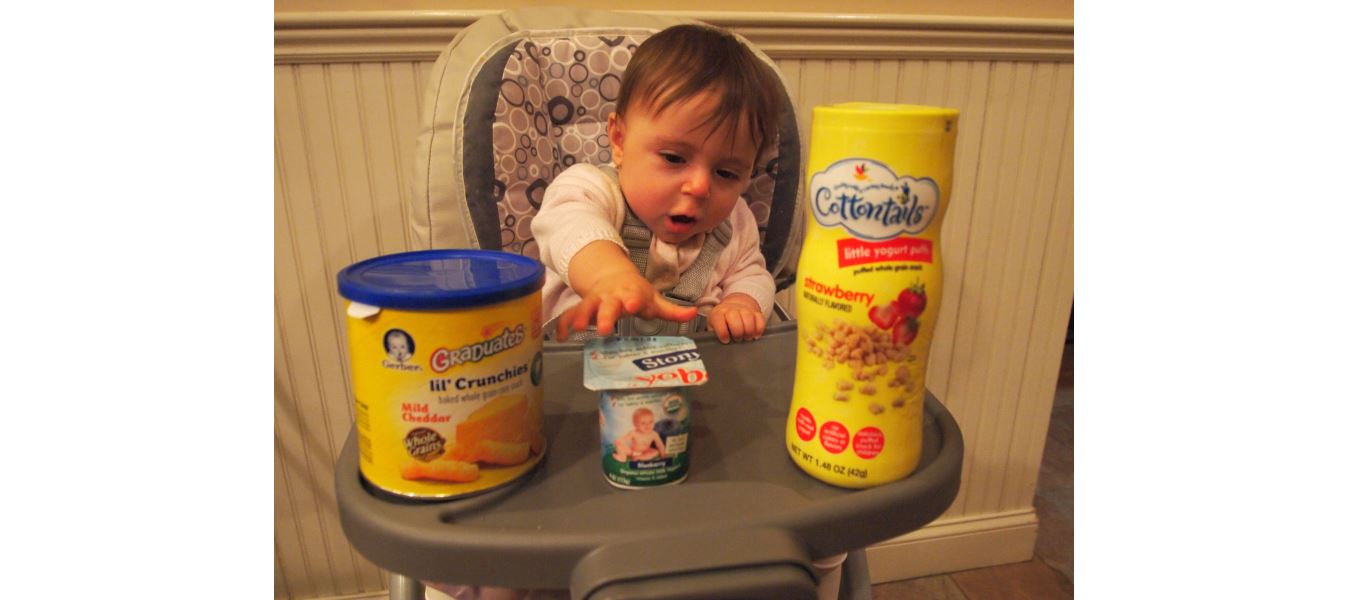
I seriously doubt that General Mills produced Cheerios specifically to be a gateway food for young children. Parents simply latched onto these bits of junk food because they are easy for a toddler to pick up and eat. Flash forward a few decades and now the food companies have thrown their hat into the ring and they are now aggressively producing and promoting highly processed finger foods for young children. I know this to be true because my wife recently purchased the items in the photo above, showing Rafaella with her gateway foods. Gerber, Nestle, General Mills and other well-know companies are battling each other to be a baby’s first exposure to solid food. My question is, what the heck did people do during the 99.9% of our evolutionary history when this type of food wasn’t available?
Fake Food, Fake Labels
If you read the labels on these products, you might be led to believe that you are giving your kid healthy food. Food companies have become very adept at avoiding toxic words like sugar, HFCS, trans fat and so on. The Cottontails product shown in the above picture contains high glycemic carbohydrates from grains (they call it “whole grains”), sugar (they call it “strawberry powder”) and omega 6 fatty acids (they call it canola oil). Virtually every product promoted as a healthy finger food contains this toxic triad.
I Can’t Believe That Somebody Makes This Stuff
The first such product that my wife brought home was compliments of Gerber—a company that has defined baby food for decades. It was a product called “Gerber Graduate Puffs” This product is clearly a classic highly processed food, yet Gerber tries to make the case that this is an ideal first food for babies. On the package and on their web site they focus on the fact that this cereal snack is made from “whole grains with eight vitamins and minerals to help support healthy growth and development. “ They also promote the fact that puffs are “easy to chew and swallow” and “just the right size for learning to pick up”. The “whole grain” moniker seems to work for adults when it comes to promoting sugary breakfast cereals, so why not try it on the kids?
Gerber also makes a product called “Graduates Lil’ Crunchies” pictured above. When you read the list of ingredients in this product, it almost exactly mimics the ingredients in the popular Frito-Lay snack “Cheetos”. Giving Cheetos to infants—I find this to be very scary indeed. The yogurt in the above picture is a product called “Yobaby” by Stonyfield Farms. Don’t get me wrong—I am married to a wonderful Greek woman and Greek yogurt is one of my favorite foods. The problem is, in this country we don’t have many brands of true Greek yogurt. The most popular brand of so-called Greek yogurt in this country is Chobani and they add a form of sugar (evaporated cane juice) to most of their products. Real Greek yogurt has a modest sweet taste and doesn’t need added sugar. The problem is, many Americans already have early CARB syndrome so their food choices are driven by their cravings. If you leave out the added sugars, the product won’t sell as well. The Yobaby product contains both sugar and organic apple puree—simply another form of sugar. The food industry tries to disguise the amount of sugar in their products, especially for babies, so they have come up with a long list of consumer friendly words for sugar. For more information on this topic I recommend that you read Robert Lustig’s book “Sugar Has 56 Names”.
Surprise—All of Us Love Junk Food
Once we had these products in the house, we ended up occasionally letting Rafaella try them out. I have to admit that despite my view of these products from a nutritional standpoint, I was curious how she would respond to them. The scary part of this situation is that she seems to love them! I guess I shouldn’t be so surprised. Most people appreciate the mouth feel and taste of highly processed food when they are exposed to it and I guess that Rafaella is no exception. So is occasional exposure to highly processed food dangerous or harmful? I suspect that the answer to this important question is no. The problem is, you don’t want to cross over the threshold of liking this type of junk food to craving it. Once you have strong cravings for highly processed food, it is a clear sign that you have transitioned to the early stages of a disease—CARB syndrome. Trust me—that’s not where you or your children want to go.
Perhaps an example would be helpful. Last week I worked with a Nurse Practitioner who has a toddler at home. We were discussing nutritional issues and she mentioned that her child was a “picky eater”. When you hear this term it almost never refers to a kid who is choosing to eat only vegetables, fruit and other whole foods. They almost always select highly processed foods and avoid whole foods. That’s because their food choices are being driven by their cravings for sweet and starchy foods, the hallmark symptom of CARB syndrome. If they continue to consume the food they are craving, they could eventually end up with some or all of the 22 symptoms of CARB syndrome as well as the metabolic problems associated with the disease. They will likely be diagnosed with ADHD, bipolar II, depression, oppositional defiance disorder or similar conditions and placed on medication by someone in the medical profession. So begins a lifetime of dysfunction, disease and distress. Of course this is not what I want for Rafaella, so goodbye Graduate Puffs, Lil’ Crunchies, Yobaby yogurt and similar fare.
Let’s Get Nutritionally Smart
That’s find and dandy, but if we cut out the junk food, just what should we be feeding our little bundles of joy? In my opinion having a new baby in the home is the ideal time to get up to speed on the healthiest way to eat for the whole family. Seeking nutritional advice from a medical professional may not be too helpful because many of them are stuck in the “count your calories and cut out the fat” mode. Thus one of the best ways to get up to speed on the latest nutritional information is to become self-educated. The easiest way to do this is to follow in the footsteps of nutritional pioneers. Listed below are some of the books and web sites that I recommend to my patients to start their nutritional education.
Gary Taubes was one of the first people to attack the calorie-centric view of diet and health in his iconic book “Good Calories, Bad Calories” and his follow up book “Why We Get Fat”. Gary walks us through the history of modern nutritional science to give us a sense of how it became so divorced from reality and common sense. He also provides us with a framework to move back in the right direction. His NuSi Foundation was set up to providing funding for nutritional research that is divorced from the influence of Big Food. If he is successful perhaps we won’t have to listen anymore to the moronic promotion of “whole grains” by the food industry.
Over the past decade or so we have become aware of the health risks associated with the simple sugar fructose. Richard Johnson has been directly involved in much of the research showing the adverse affects of excessive fructose. He has also written two excellent books on the topic: “The Sugar Fix” and “The Fat Switch”. Robert Lustig has led the charge when it comes to promoting the idea that sugar is toxic. His accomplishments are almost too numerous to mention but to summarize, he has provided us with the framework to eventually regulate or tax sugar. Impossible you say? Think again. Yes indeed, former New York City Mayor Michael Blomberg failed to restrict soda sales to 16 ounces or less and many folks believed that this was the end of the effort to regulate sugar. Let’s head south and see what others are up to. Mexico recently enacted a 10% tax on sugary beverages and soda sales are starting to plunge. Mexicans are the largest per capita consumers of Coke in the world. 30% of Mexicans are now obese and 14% have type II diabetes. It looks like its time for them to push the panic button and they have done so. If Dr. Lustig has his way, some day soon we will have a similar tax in this country and he certainly has my vote. We tax other dangerous products like tobacco and alcohol that cost our society billions of dollars every year. Yes Dr. Lustig, it’s now time to add sugar to this list.
What the Heck Should We Eat?
If calories no longer count, what does? In my mind the answer is food composition. Pay attention to what you eat, not how much you eat. Fortunately there are a lot of web sites out there who have answered this important question. In my opinion the best sites have a Paleo orientation. These sites are based on the concept that we should be feeding our children whole real food, not fake food. When it comes to the science of eating, Robb Wolf blasts the junk food folks out of the water with this excellent post. Eat real whole food and feed it to your kids. It’s a simple message loaded with tons of wisdom. I highly recommend that you spend some time on his web site and read his books.
Robb Wolf is a student of the man who started the modern Paleo movement—Lorne Cordain. I also recommend that you spend some time on his web site and read his books. Dr. Cordain has the unique ability to combine solid science, evolutionary biology and common sense in a way that we haven’t seen since Charles Darwin. If you want to have a healthy life for you and your children, Dr. Cordain definitely has the blueprint for doing so.
Because for decades my special interest has been the connection between food and brain function, I was heartened to see David Perlmutter publish his book “Grain Brain”. David and I agree that for too long the brain has been left out of the discussion about diet and health and we both agree that one of the first organs in your body to be adversely affected by eating a diet of highly processed foods is your brain. Trust me—you do want to bring your brain with you as your age.
Let’s not forget about the issue of fat. For decades fat has been the demon, that is until Jimmy Moore came along and turned the world of nutrition upside down and inside out. His recent book “Keto Clarity” wrestles the issue of fat to the mat: is fat good for us or bad for us? The answer is a bit nuanced. Can you say: “Two edged sword?” If you consume your fat in the form of processed food, don’t be surprised if your health plummets. If you consume your fat from whole foods and animals, be prepared to enjoy improved health and brain function.
As the Beatle’s once some famously stated: “I get by with a little help from my friends”. When it comes to nutrition, this is certainly the case. Of all the things that we do in the world, supporting the health and well being of the next generation should top the list. Rafaella, I have your back.