

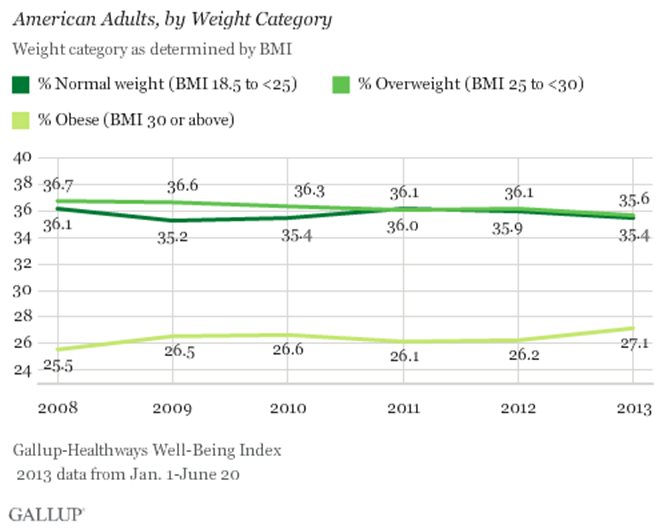
The Gallop Well-being poll has been tracking obesity rates since 2008 and so far this year the rate has increased from 26.2% to 27.2%, the largest increase since they starting tracking obesity in adults. Obesity rates also vary by race and this year 35.7% of blacks are now obese. These rates had plateaued for several years but now once again appear to be rising at an alarming rate. These figures are based on body mass index (BMI), a number that essentially measures body size but doesn’t really tell you how much fat is in your body.
It’s Worse Than We Thought
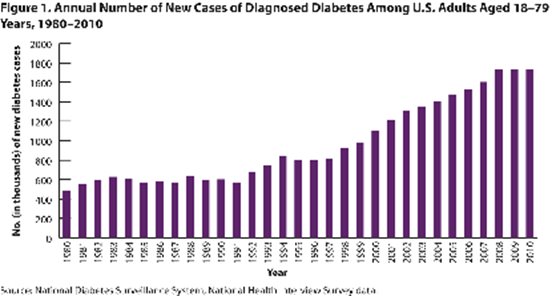
Because obesity is defined as excessive body fat, using a proxy measure like BMI might be problematic. Although BMI and amount of body fat correlate someone in large populations, this doesn’t always hold true for individuals. A recent article in the European Journal of Clinical Nutrition points out the BMI is likely not a useful measure in medical studies and they suggest that we move towards using a measure called “functional body composition”. Functional body composition also takes into account worrisome metabolic markers like diabetes that are sometimes but not always associated with obesity. As demonstrated by the graph below, the incidence of diabetes is increasing even more rapidly than the incidence of obesity.
Thus if you combine excessive body fat (obesity) with insulin resistance or type II diabetes, you get a much more complete picture of overall health. This article also points out that up to 30% of obese people are metabolically healthy. Other studies have shown that up to 40% of people with a normal BMI has some degree of insulin resistance. This is especially important to consider when it comes to brain health, my main area of interest. Inflammation is another important marker when it comes to metabolic health.
David Perlmutter points out in his excellent book “Grain Brain” that insulin resistance and diabetes are strongly associated with dementia and cognitive decline. Some of these individuals fit a pattern of food-induced brain dysfunction that we now call Carbohydrate Associated Reversible Brain syndrome or CARB syndrome. People with CARB syndrome can develop up to 22 brain dysfunction symptoms that interfere with their ability to function and they also tend to have metabolic problems like insulin resistance and type II diabetes.
If a large percent of people with and without obesity have food-induced brain dysfunction or CARB syndrome, it’s even worse than we thought. That’s why I focus on the brain. After all, as you grow older you want to bring your brain with you! In my opinion the headlines should be screaming that our national brain function is heading in the wrong direction. Carrying around a few extra pounds pales in comparison to trying to get by in this complex world with less than ideal brain function. In recent years many studies have shown a strong association between insulin resistance and cognitive decline.
To unpack this situation we need to look carefully on what is driving these metabolic problems. Insulin resistance seems to start in the liver when it is exposed to excessive amounts of fructose, mainly from sugar and HFCS. Some studies have also correlated diets with a high glycemic load with insulin resistance and diabetes. Although the exact role of these dietary elements in driving our current epidemic of metabolic and brain disorders has yet to be determined in humans, various people have their own opinions. Richard Johnson focuses on the role of fructose in his books “The Sugar Fix” and “The Fat Switch”. Robert Lustig also tends to lean in this direction in his book “Fat Chance”. Gary Taubes focuses on carbohydrates in his books “Good Calories, Bad Calories” and “Why We Get Fat”. Barry Sears focuses on fatty acids in his book “Toxic Fat”. I suspect that to some degree they are all right and that brings us once again to focusing on processed food that is loaded with these dietary elements.
In my opinion, as bad as our epidemic of obesity and metabolic problems appears to be, they pale when compared to our current epidemic of brain problems driven by consuming the Standard American Diet. Obesity and metabolic problems are the earthquake and common brain disorders are the 30 foot tsunami that is about to sweep over us, yet very few people are focusing on the brain. David Perlmutter has opened the door with his book “Grain Brain” and I believe the CARB syndrome concept will focus more light on this important issue.
Grab The Bull by the Horns
Fortunately, you don’t need to wait until everyone else gets up to speed. You can grab the bull by the horns today and take concrete steps to protect your metabolic and brain health. It doesn’t take a rocket scientist to figure out what to do. You need to eliminate the triggers of CARB syndrome from your diet. The easiest way to do so is to remove processed food from your diet and switch to a whole foods diet. Following a Paleo style diet works well for many people. I recommend reading Loren Cordain’s book “The Paleo Answer” or Robb Wolf’s book “The Paleo Solution” for more specifics on this type of diet. In recent years a ketogenic diet has been gaining steam as a healthy way to eat, especially when it comes to your brain. Jimmy Moore has a lot of information on this type of diet on his web site.
It is a little depressing to sit back and listen to the statistics concerning common metabolic and brain problems. Obesity is now the norm in our society and every Tom, Dick and Harry seems to have some type of brain disorder. But this doesn’t have to be you. You can take control of your life and move in a better direction. The solution is well within your reach. Eat real whole food and avoid fake processed food. Do what grandma told you to do. “You are what you eat”. I must say, grandma knew a thing or two about life. Sometimes we need to go backwards to find wisdom.